
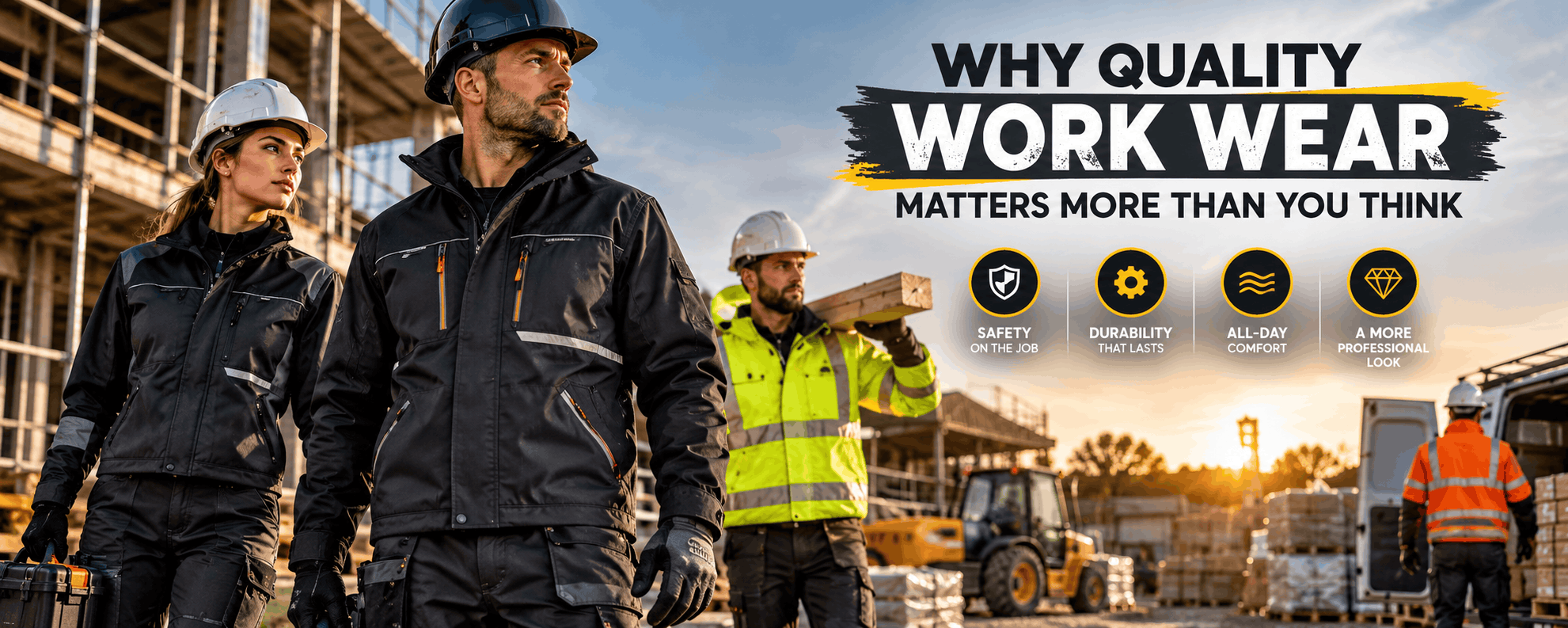
What you wear to work can make a bigger difference than you might expect. Whether you’re working on a construction site, managing warehouse operations, or handling demanding outdoor tasks, your clothing affects how comfortably and confidently you perform throughout the day.
However, choosing the right work wear involves much more than finding something that looks professional. Quality work clothing should offer durability, practical functionality, freedom of movement, and, where necessary, protection against workplace hazards.
Furthermore, poorly fitted or unsuitable clothing can restrict movement, wear out quickly, and create unnecessary discomfort. Therefore, investing in well-designed workwear is an important decision for both employees and employers.
In this guide, we’ll explore why quality work wear matters, what features deserve your attention, and how to choose suitable clothing for different working environments.
What Is Work Wear and Why Is It Important?
Work wear refers to clothing specifically designed or selected for professional activities. Unlike everyday fashion, workwear focuses on practical features such as durable fabrics, comfortable fits, reinforced stitching, and functional pockets.
Depending on the industry, work clothing may include trousers, jackets, coveralls, high-visibility garments, uniforms, and protective clothing.
More importantly, workwear serves different purposes depending on the workplace. For example, warehouse employees may prioritise flexibility, while construction workers may require additional durability and task-specific protection.
Quality work wear matters because it supports comfort, durability, mobility, and workplace suitability. When properly selected, it can help employees perform daily tasks without unnecessary clothing-related distractions.
Nevertheless, ordinary workwear and certified personal protective equipment (PPE) are not always the same. Clothing intended to protect against specific hazards must meet the relevant safety requirements.
1. Quality Work Wear Supports Workplace Safety
Safety should always be considered when selecting clothing for physically demanding jobs.
For instance, employees working near moving vehicles may require high-visibility clothing, while workers exposed to particular environmental hazards may need specialised protective garments.
According to the UK’s Health and Safety Executive (HSE), employers must assess workplace risks and provide suitable PPE free of charge when those risks cannot be adequately controlled through other measures.
However, wearing any heavy-duty jacket or pair of trousers does not automatically provide certified protection.
Instead, the clothing must be appropriate for the specific hazards involved.
How can suitable work clothing improve safety?
Properly selected workwear can contribute to workplace safety in several ways:
- High-visibility garments can make workers easier to see around vehicles and machinery.
- Appropriate protective fabrics can reduce exposure to certain workplace hazards when correctly specified.
- Well-fitted clothing can reduce the likelihood of loose material catching on equipment.
- Weather-resistant garments can help workers remain comfortable in challenging outdoor conditions.
Consequently, businesses should consider workplace risk assessments before purchasing protective clothing rather than selecting products based on appearance alone.
2. Comfortable Work Wear Can Make Long Shifts Easier
Imagine spending eight hours lifting materials, bending, walking, or operating equipment while wearing uncomfortable clothing.
Even simple activities can become frustrating when trousers feel restrictive or jackets limit arm movement.
Therefore, comfort is an essential feature of practical work clothing.
High-quality workwear often incorporates thoughtful design elements such as articulated knees, adjustable waistbands, flexible panels, and breathable materials.
Additionally, appropriate fabric selection can help manage temperature and moisture during physically demanding activities.
For example, workers in warmer environments may prefer lightweight, breathable fabrics. Meanwhile, employees working outdoors during colder months may benefit from insulated or layered clothing.
As a result, choosing clothing suited to both the job and working conditions can help employees stay focused on their responsibilities.
3. Durable Work Wear Can Offer Better Long-Term Value
Although cheaper work clothing may appear attractive initially, frequent replacements can make it more expensive over time.
For example, trousers that tear after a few weeks of regular use may need replacing much sooner than garments designed for demanding environments.
Therefore, durability should be considered alongside the purchase price.
Quality workwear commonly includes features such as reinforced seams, abrasion-resistant fabrics, strong zips, and additional stitching in high-stress areas.
Furthermore, some work wear trousers feature reinforced knee sections that can withstand repeated kneeling and movement more effectively than ordinary casual trousers.
What makes workwear durable?
Several construction details can influence how well a garment performs:
- Fabric composition: Suitable cotton, polyester, or blended fabrics can provide different balances of comfort and strength.
- Stitching quality: Reinforced seams can help withstand repeated movement and strain.
- Fastenings: Durable buttons and zips are important for everyday reliability.
- Reinforced areas: Extra fabric in high-wear locations can extend useful garment life.
- Care requirements: Clothing that tolerates appropriate regular washing may be easier to maintain.
Ultimately, the best value comes from clothing that remains suitable and functional throughout its expected working life.
4. Choosing the Right Work Wear Trousers Matters
Work wear trousers are among the most important garments for professionals who spend their days moving, lifting, crouching, or kneeling.
However, not every pair of trousers is suitable for every job.
For instance, electricians may benefit from multiple secure tool pockets, while warehouse employees may prefer lightweight trousers that allow comfortable movement.
Similarly, tradespeople who regularly kneel may find reinforced knee areas particularly useful.
Features to look for in work wear trousers
| Feature | Practical benefit |
|---|---|
| Reinforced knees | Additional durability in high-wear areas |
| Stretch panels | Greater flexibility during movement |
| Multiple pockets | Convenient storage for tools and essentials |
| Adjustable waistband | More comfortable, secure fit |
| Durable stitching | Better resistance to everyday strain |
| Breathable fabric | Improved comfort in warmer conditions |
Additionally, the correct trouser length matters. Excessively long trousers can interfere with movement, while overly tight clothing may restrict bending.
Therefore, checking size charts and considering your normal working movements can help you choose more suitable trousers.
5. A Quality Work Wear Jacket Offers More Than Warmth
A reliable work wear jacket can be an important part of a worker’s daily clothing, particularly in the UK’s changing weather conditions.
However, the best jacket depends on the environment and type of work being performed.
For example, a lightweight softshell jacket may be suitable for active outdoor tasks in mild weather. Conversely, colder conditions may call for insulated clothing that supports comfortable layering.
Furthermore, waterproof protection can be important for employees who regularly work in rain.
What should you look for in a work wear jacket?
Consider these features before purchasing:
- Weather resistance appropriate to the working conditions.
- Breathable materials to help manage heat and moisture.
- Adjustable cuffs and hems for a more secure fit.
- Functional pockets with reliable closures.
- Comfortable shoulder and arm movement.
- Compatibility with any required safety equipment.
Importantly, a water-resistant jacket is not necessarily fully waterproof, and a standard outdoor jacket should not be assumed to provide high-visibility or other certified protection.
Therefore, always check the product specifications before deciding whether a jacket is appropriate for your workplace.
6. Why Properly Fitted Work Wear for Women Matters
Finding suitable work wear for women can sometimes be challenging, particularly when clothing ranges offer limited sizing or rely on designs intended for different body proportions.
However, workplace clothing should fit the individual rather than requiring the individual to adapt to an unsuitable garment.
For example, trousers with an inappropriate waist-to-hip ratio may restrict movement or require constant adjustment.
Similarly, oversized jackets may interfere with practical tasks or make it difficult to wear additional protective equipment correctly.
Consequently, choosing women’s workwear with appropriate sizing, adjustable features, and practical cuts can improve comfort and usability.
Important features of women’s workwear
Well-designed women’s work clothing should offer:
- A suitable range of sizes and fits.
- Comfortable waist and hip proportions.
- Practical pocket placement.
- Adequate freedom of movement.
- Appropriate sleeve and trouser lengths.
- The same task-specific performance requirements as other workwear.
Moreover, protective clothing must fit correctly to function as intended. HSE guidance specifically highlights size, fit, compatibility, and the physical characteristics of the wearer when selecting PPE.
Ultimately, comfortable, properly fitted clothing should be accessible to everyone working in demanding environments.
7. Men’s Work Wear Should Balance Strength and Flexibility
When selecting men’s work wear, durability is often a major consideration. Nevertheless, strength alone does not make a garment suitable.
For example, extremely heavy fabrics may resist abrasion but feel uncomfortable during physically active tasks in warmer conditions.
Likewise, overly loose trousers can interfere with movement, while restrictive jackets can make reaching and lifting more difficult.
Therefore, the best men’s workwear combines practical construction with a fit suited to the worker’s activities.
Popular options include cargo work trousers, utility jackets, work shirts, coveralls, and weather-resistant outerwear.
Additionally, choosing garments based on specific job requirements can be more effective than purchasing the heaviest available clothing.
For instance, someone working indoors may prioritise breathability, whereas an outdoor maintenance worker may need greater weather protection.
8. Quality Work Wear Can Support a Professional Appearance
Work clothing also influences how a business presents itself.
When employees wear clean, consistent, and appropriate clothing, they can create a more organised and professional impression.
This can be particularly valuable for customer-facing industries such as maintenance, installation, logistics, and property services.
Furthermore, branded workwear can make team members easier to identify and help reinforce a company’s visual identity.
However, professional appearance should never come at the expense of comfort or safety.
Instead, businesses should select clothing that combines practical functionality with a consistent appearance.
As a result, employees can represent their organisation professionally while remaining suitably dressed for their responsibilities.
9. How to Choose the Best Work Wear for Your Industry
Different industries place different demands on work clothing. Consequently, a garment that performs well in one environment may be unsuitable in another.
The following examples illustrate common considerations.
| Industry | Important workwear considerations |
|---|---|
| Construction | Durable trousers, reinforced areas, task-specific PPE |
| Warehousing | Flexible clothing, breathable fabrics, suitable fit |
| Logistics | Comfortable layers, practical pockets, visibility where required |
| Manufacturing | Appropriate fit, machinery-related hazards, required protective clothing |
| Outdoor maintenance | Weather resistance, layering, freedom of movement |
| Facilities management | Durable everyday clothing, professional appearance, functional storage |
Nevertheless, these are general considerations rather than complete safety specifications.
Before selecting protective garments, employers should assess the actual workplace hazards and check the relevant product standards.
10. How to Maintain Work Wear for Longer-Lasting Performance
Even high-quality workwear requires proper care.
For instance, washing garments at unsuitable temperatures or using inappropriate cleaning products can damage certain fabrics and finishes.
Similarly, ignoring damaged seams or broken fastenings may reduce the garment’s useful life.
Therefore, regular maintenance is essential.
Start by checking the manufacturer’s care label and washing instructions. Additionally, inspect frequently used clothing for tears, worn fabric, damaged closures, or other signs of deterioration.
Where appropriate, repair minor defects before they become larger problems.
However, protective clothing requires particular attention. If damage or contamination affects its protective performance, it must be assessed and replaced when necessary.
HSE guidance makes employers responsible for ensuring required PPE is appropriately maintained, stored, and replaced.
Consequently, proper maintenance supports both the longevity and continued suitability of work clothing.
Frequently Asked Questions
There is no universal replacement schedule for ordinary workwear. However, garments should be replaced when wear, damage, poor fit, or deterioration makes them unsuitable. Protective clothing must also follow applicable inspection and replacement requirements.
Not necessarily. Price alone does not guarantee quality. Instead, compare fabric construction, stitching, fit, durability, intended use, and relevant certifications before purchasing.
A work wear jacket should allow comfortable movement without excessive loose fabric. Moreover, it should accommodate necessary layers and remain compatible with any other required protective equipment.
Yes. Many work wear trousers can be worn for everyday activities because they offer practical pockets and durable construction. Nevertheless, specialised protective trousers should be selected according to their intended purpose.
The best fabric depends on the job. Cotton can offer comfort and breathability, while polyester blends may provide useful durability and easier care. Additionally, stretch fabrics can improve flexibility. However, protective applications may require specially certified materials.
Work wear is a broad category of clothing designed or selected for professional tasks, while protective clothing is specifically intended to reduce exposure to identified hazards. Therefore, not all workwear qualifies as PPE.
Final Thoughts:
Quality work wear is more than just clothing worn during working hours. It is an important part of staying comfortable, maintaining a professional appearance, and supporting practical performance throughout the working day.
Whether you’re choosing men’s work wear, women’s work clothing, durable work wear trousers, or a dependable work wear jacket, the priority should always be suitability for the job.
Furthermore, focusing on fit, fabric quality, durability, and maintenance can help you make better purchasing decisions.
Most importantly, where workplace hazards require protective clothing, appropriate safety standards and risk assessments must guide your choice.
Explore the workwear options at MT Sports UK and choose clothing that suits your everyday working needs.
One Comment