
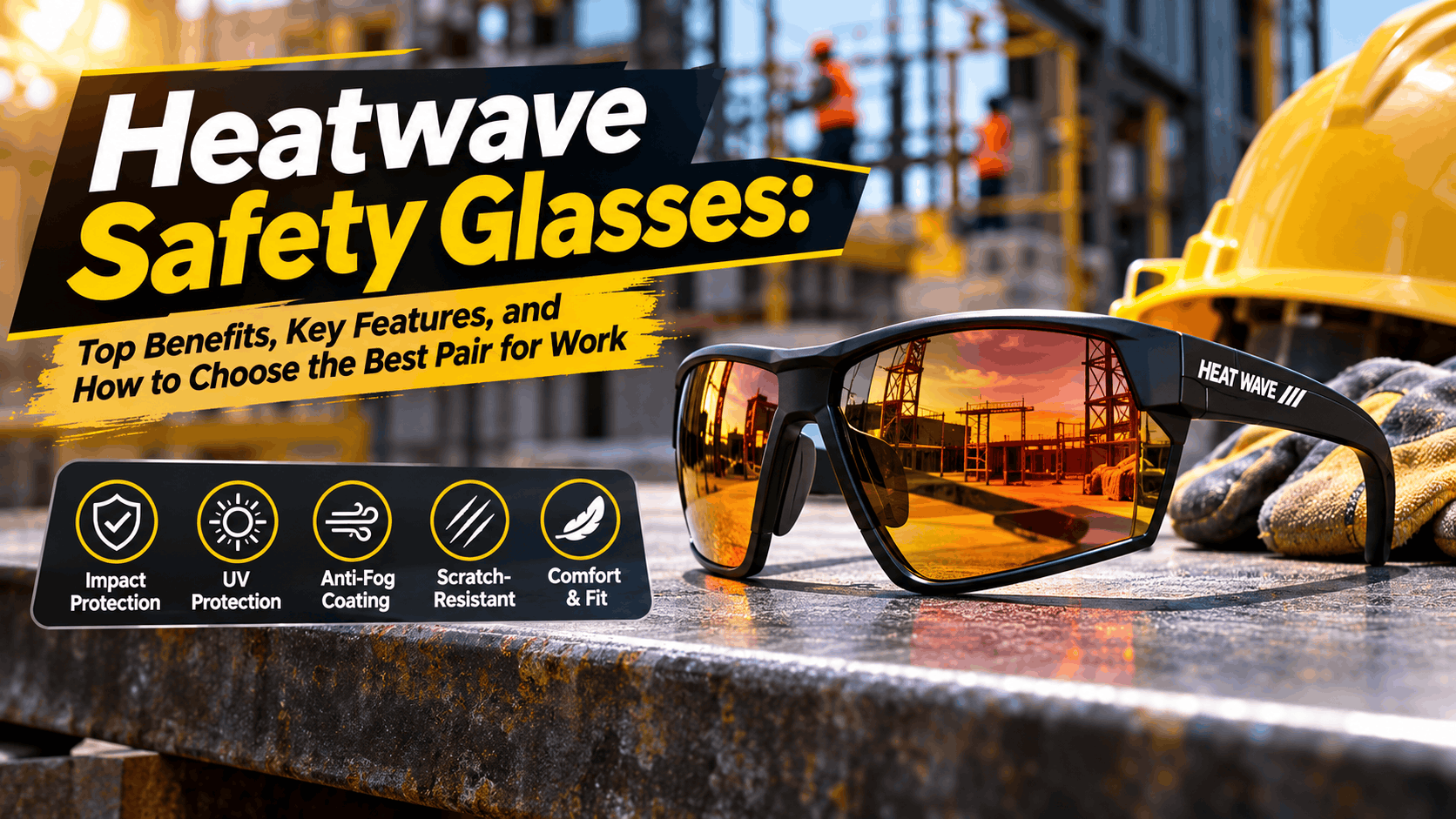
Working on a construction site, cutting timber in a workshop, or spending hours outdoors can expose your eyes to flying debris, dust, glare, and unexpected hazards. One small particle can interrupt your work and potentially cause a serious eye injury. That’s why choosing suitable protective eyewear matters. Heatwave safety glasses combine contemporary eyewear styling with protective features designed for demanding environments. However, not every pair offers the same level of protection, and ordinary sunglasses cannot replace properly rated workplace safety glasses.
Whether you’re a construction worker, warehouse employee, technician, or outdoor tradesperson, understanding the differences between lens materials, safety ratings, and protective features can help you make a safer purchase.
This guide explores the benefits of Heat Wave eyewear, important specifications, comparisons with Milwaukee safety glasses, and practical advice for choosing the right pair for your working conditions.
What Are Heatwave Safety Glasses?
Heatwave safety glasses are protective eyewear products offered by Heat Wave Visual, a brand known for combining modern sunglasses-inspired designs with occupational eye protection. Its safety range includes models marked Z87 or Z87+, although the protective capabilities depend on the exact model, configuration, and applicable certification.
Unlike ordinary fashion sunglasses, safety-rated eyewear is designed and assessed against relevant protective performance requirements.
According to Heat Wave Visual’s official safety instructions, its Z87+ products are assessed against ANSI Z87.1-2020 impact requirements, with appropriate lateral protection provided through the frame or compatible side shields. Heat Wave Visual+1
Typical features available across the brand’s safety collection include:
- Impact-resistant protective lenses.
- Side shields or frames designed to provide lateral coverage.
- Clear, tinted, or photochromic lens options.
- Anti-fog treatments on selected products.
- Lightweight, contemporary frame designs.
However, a Z87 marking alone does not establish Z87+ high-impact protection, and US standards do not automatically establish compliance with UK workplace requirements.
Top Benefits of Heatwave Safety Glasses
1. Impact Protection Against Workplace Hazards
Flying particles are common during drilling, cutting, woodworking, and general maintenance.
Appropriately rated heat wave safety glasses can help reduce exposure to specified impact hazards, particularly when the eyewear includes the side protection required for the task.
However, safety spectacles are not suitable for every hazard. High-energy particles, fine dust, and chemical splashes may require goggles or additional protective equipment.
2. UV Protection for Outdoor Workers
Outdoor employees often work under bright sunlight for several hours.
UV-rated safety lenses can help reduce harmful ultraviolet exposure, while appropriate tinted lenses may improve comfort by reducing glare.
Do Heat Wave safety glasses provide UV protection?
Some Heat Wave models offer UV-filtering features. However, UV protection must be verified for the particular lens selected. A dark appearance does not automatically demonstrate suitable UV filtration or impact resistance.
3. Comfortable Designs for Longer Shifts
Protective eyewear is most useful when workers can wear it consistently.
Lightweight frames, comfortable nose contact points, flexible temples, and an appropriate fit can reduce pressure during extended use.
For example, a warehouse employee who frequently bends, lifts, and moves between workstations needs glasses that remain secure without constant adjustment.
4. Clear Visibility in Changing Conditions
Poor visibility can create additional workplace risks.
Clear lenses are generally useful indoors, while suitable tinted lenses can reduce sunlight-related discomfort outdoors.
Additionally, certain photochromic options adjust their tint in response to changing light conditions.
The correct lens choice should preserve visibility for the task rather than simply provide the darkest possible tint.
5. Anti-Fog and Scratch-Resistant Options
Moving between warm outdoor conditions and cooler indoor spaces can cause lenses to mist.
Anti-fog coatings may help reduce condensation. Meanwhile, scratch-resistant treatments can improve everyday durability, although they do not make lenses scratchproof.
Heat Wave’s official collection includes selected anti-fog and lens-protection options, but availability varies by product. Heat Wave Visual
6. Practical Styling for Everyday Wear
Modern safety glasses no longer need to resemble bulky, traditional industrial eyewear.
Heat Wave offers several style-led frame designs, which may appeal to workers who prefer a more contemporary appearance.
Nevertheless, protective coverage, fit, and task suitability should always take priority over styling.
Key Features to Look for When Buying Heatwave Safety Glasses
Before purchasing protective eyewear, evaluate the specifications rather than relying on product photographs.
Safety Ratings and Certification
Understanding the relevant standards is essential, especially for UK employers purchasing workplace PPE.
| Standard | What buyers should know |
|---|---|
| ANSI/ISEA Z87.1 | US standard addressing occupational eye and face protection; markings identify applicable performance categories |
| EN 166 | Former European general eye-protection standard, relevant to certain previously certified products |
| EN ISO 16321-1 | Updated standard covering general occupational eye and face protection |
| EN ISO 16321-2 | Additional requirements for welding-related eye and face protection |
According to BSI, EN ISO 16321 replaced EN 166 for new certifications from 11 November 2025, with transitional provisions for qualifying existing certificates. BSI UK
UK buyers should therefore confirm the exact product’s applicable conformity documentation, certification status, markings, and suitability for the employer’s risk assessment.
Lens Materials and Impact Resistance
Polycarbonate is commonly used in industrial safety glasses because it combines low weight with useful impact resistance.
However, lens material alone does not demonstrate that finished eyewear meets a particular standard.
The complete protective device, including its lenses, frame, and required side protection, must be appropriately assessed.
UV Protection and Lens Tint
Choose clear lenses for tasks requiring accurate indoor visibility and suitable filtered lenses for outdoor conditions.
Additionally, check whether lens tint could interfere with reading displays, identifying warning signals, or judging colours.
Anti-Fog Technology
Anti-fog coatings can be useful in humid workshops, busy warehouses, and environments involving temperature changes.
However, ventilation, lens maintenance, and working conditions also affect fogging.
Frame Design and Side Coverage
Look for adequate coverage around the sides of your eyes.
For example, an open-sided frame might leave workers exposed to particles approaching from an angle.
Fit and Compatibility With PPE
Safety glasses should sit securely without interfering with helmets, hearing protection, or respiratory equipment.
If you wear prescription spectacles, consider properly rated prescription safety eyewear or suitable over-glasses protection.
Heatwave Safety Glasses vs Milwaukee Safety Glasses
What is the difference between Heat Wave and Milwaukee safety glasses?
Heat Wave Visual places considerable emphasis on contemporary frame styling alongside its ANSI-rated safety range. Milwaukee offers a worksite-oriented selection of protective eyewear, including clear, tinted, anti-fog, and other specialist options. Neither brand should be considered universally safer without comparing specific models and certifications.
| Feature | Heat Wave Visual | Milwaukee |
|---|---|---|
| Design approach | Contemporary, sunglasses-inspired styling | Practical, worksite-focused designs |
| Lens options | Clear, tinted, photochromic options in selected ranges | Clear, tinted, photochromic and other options |
| Anti-fog protection | Available on selected models | Available on selected models |
| Side protection | Integrated or compatible side shields, depending on model | Model-dependent coverage |
| Certification | ANSI Z87/Z87+ on designated safety products | UK range documents EN 166 certification for listed products |
| Best buying consideration | Verify UK suitability and exact model markings | Verify current model certification and required protection |
Sources: Heat Wave Visual safety collection and Milwaukee UK safety glasses. Heat Wave Visual+1
For UK businesses, the most useful comparison is between two specific products with documented protective performance, rather than their brand names alone.
How to Choose the Best Heatwave Safety Glasses for Your Work
Choosing appropriate eyewear begins with identifying the hazards present in your workplace.
Step 1: Identify Your Working Environment
Different jobs require different protective features.
| Working environment | Protection to prioritise |
|---|---|
| Construction sites | Impact rating, lateral coverage, secure fit |
| Warehouses | Comfortable frames, clear visibility, appropriate impact protection |
| Outdoor work | Suitable UV filtration, glare control, secure fit |
| Manufacturing | Task-specific impact resistance and appropriate coverage |
| Laboratories | Protection against relevant splashes, particles or other hazards |
| Mixed indoor/outdoor work | Suitable clear, tinted or photochromic options |
Step 2: Consider Changing Light Conditions
Can transition safety glasses be used at work?
Yes, appropriately certified photochromic safety glasses may be useful for certain tasks involving changes between indoor and outdoor lighting.
Their lenses automatically change tint in response to light exposure.
However, the transition speed, operating temperature, and level of darkening vary by product. Some lenses also behave differently behind vehicle windscreens.
Consequently, they should be selected only when their performance suits the workplace and visibility requirements.
Step 3: Assess Specialist Hazards
Construction and workshop tasks may require more than basic safety spectacles.
For instance, fine dust, chemical liquids, and high-energy projectiles may call for sealed or specialist goggles.
Similarly, lab safety glasses may protect against certain particles but are not automatically suitable for chemical splash hazards.
The UK Health and Safety Executive advises selecting eye protection according to the actual hazards, including impact, dust, splash, and radiation. HSE
Step 4: Check the Fit Before Purchasing
Glasses that repeatedly slide down your nose or interfere with other PPE are unsuitable for comfortable, consistent use.
Where possible, test the frame’s stability, peripheral visibility, pressure points, and compatibility with other protective equipment.
Are Heatwave Safety Glasses Suitable for Welding?
Ordinary safety glasses are not adequate primary protection for welding arcs. Welding exposes workers to potentially dangerous optical radiation, intense visible light, hot particles, and sparks. Appropriate welding helmets or other task-rated welding eye and face protection must be selected according to the process and exposure.
Even dark-tinted safety glasses should never be assumed to provide suitable welding protection.
Proper welding safety glasses, goggles, helmets, or filters must be selected for the particular welding or cutting activity, with the correct filter shade and applicable certification.
Additionally, grinding may require impact-rated eye protection together with suitable face protection.
The requirements differ between arc welding, gas welding, cutting, and grinding. Therefore, always follow the employer’s risk assessment, equipment instructions, and applicable occupational safety guidance.
The ISO 16321-2 standard specifically addresses additional protective requirements for welding-related applications. ISO
Where to Buy Heatwave Safety Glasses
When searching online for safety glasses near me, look beyond product availability and focus on trustworthy suppliers.
Before ordering, confirm the retailer provides an identifiable manufacturer, exact model number, relevant safety markings, and clear product documentation.
For UK workplace purchasing, ask whether the supplier can provide applicable conformity information and verify the protective eyewear’s suitability for the intended task.
Additionally, compare lens options, frame dimensions, delivery arrangements, warranty conditions, and return policies.
The official Heat Wave Visual website is useful for checking model specifications, but UK buyers should independently establish regulatory suitability rather than assuming a US-rated product meets every UK requirement.
How to Clean and Maintain Safety Glasses
Even high-quality protective eyewear requires regular care.
Follow these practical maintenance habits:
- Remove loose particles first. Rinse with clean water where permitted by the manufacturer’s instructions to avoid rubbing abrasive debris into the lenses.
- Use suitable cleaning materials. Clean lenses with approved cleaning solutions and a soft microfibre cloth.
- Avoid damaging chemicals. Solvents and unsuitable household cleaners may harm lens coatings or frames.
- Store glasses properly. Keep them in a clean protective case when not in use.
- Inspect before each shift. Check for cracks, deep scratches, damaged side shields, loose components, and distorted frames.
- Replace compromised eyewear. If damage affects visibility, fit, or protective performance, replace the glasses rather than continuing to use them.
Moreover, inspect safety eyewear following a significant impact, even if visible damage appears limited.
Final Thoughts — Are Heatwave Safety Glasses Worth Buying?
Heatwave safety glasses can be worth considering if you want modern-looking protective eyewear with features suited to your work.
Certain Heat Wave models combine impact-related safety specifications with options such as photochromic lenses, anti-fog treatments, and additional side coverage.
However, appearance and brand reputation should never replace proper safety verification.
For UK workers, the most important factors are the exact product’s applicable certification, the hazards identified in the workplace risk assessment, suitable lens characteristics, and comfortable fit.
Choose protective eyewear for the job you perform, not simply the design you prefer. Well-matched safety glasses are a practical part of protecting your eyesight throughout the working day.
Frequently Asked Questions About Heatwave Safety Glasses
A .They may be suitable for certain construction tasks when the exact product has appropriate impact protection, lateral coverage, fit, and applicable certification. However, construction sites involve varied hazards, so the employer’s risk assessment must determine which protective eyewear is acceptable.
A .UV protection varies between lens models. Buyers should check the manufacturer’s documented UV-filtering claims and relevant markings before assuming a particular pair provides UV400 protection. Dark lenses alone do not establish that level of filtration.
A .Only if the specific product is designed and rated for that purpose. Alternatively, consider certified prescription safety eyewear or appropriate over-spectacle protectors. Ordinary safety glasses worn incorrectly over prescription frames may compromise fit and protection.
A .ANSI Z87 identifies eyewear meeting applicable standard requirements, while Z87+ indicates high-impact protection. The marking and configuration must be verified on the complete product, including any required side shields.
A .US ANSI markings alone do not establish UK regulatory conformity. Employers should request appropriate UK conformity documentation, confirm the applicable certification and verify the eyewear is suitable for their workplace hazards.
A .There is no single replacement interval suitable for every product and workplace. Replace eyewear when it is damaged, no longer fits correctly, has impaired visibility, or has been subjected to an impact requiring replacement under manufacturer instructions. Regular inspection is essential.