
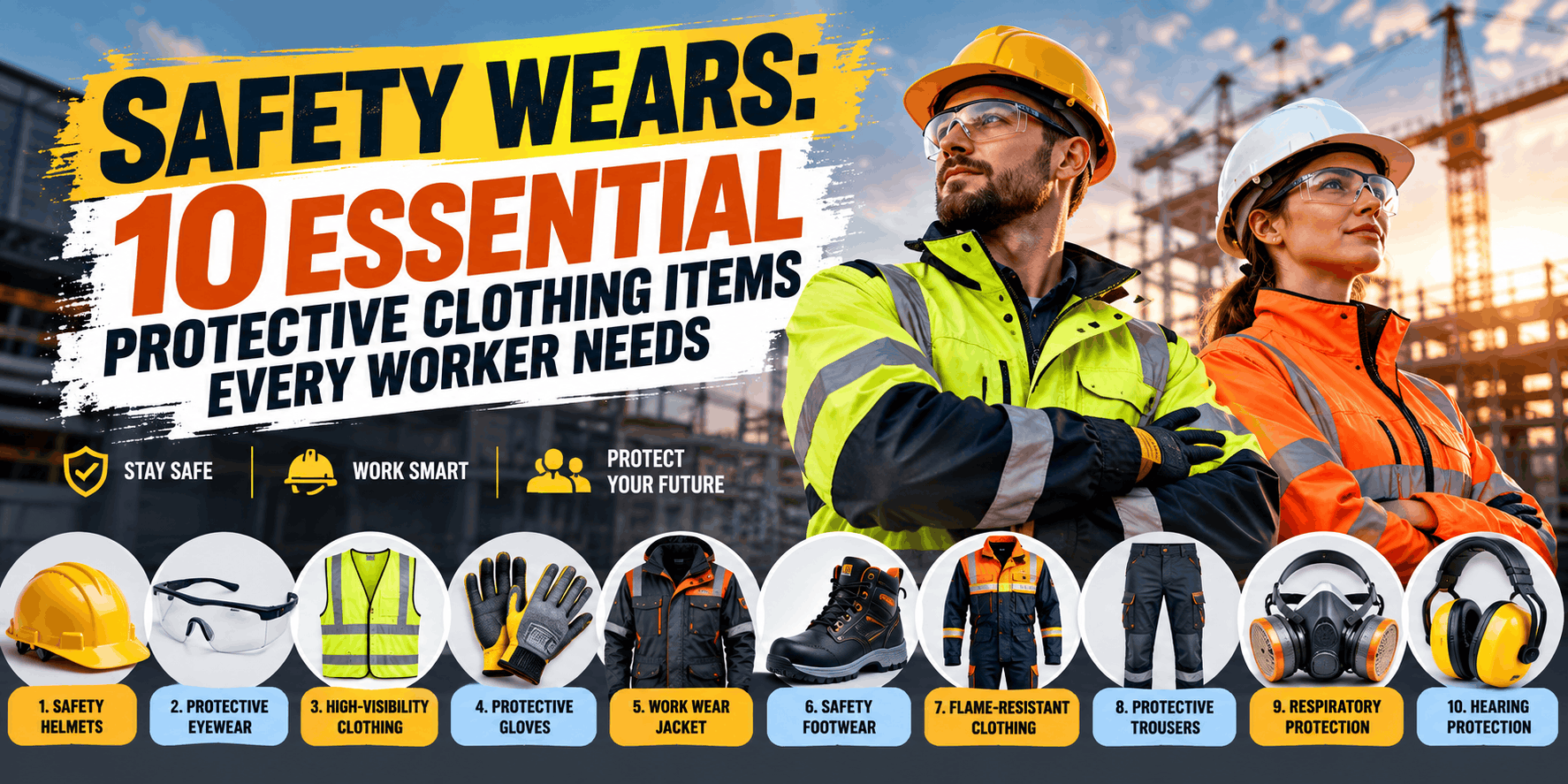
Safety Wears help reduce the likelihood or severity of injuries when workplace hazards cannot be adequately eliminated or controlled through other measures.
For example, construction workers may require head protection against falling objects, while manufacturing employees may need cut-resistant gloves when handling sharp materials.
According to the Occupational Safety and Health Administration (OSHA), employers must assess workplace hazards and provide appropriate PPE when required.
Nevertheless, protective equipment is not a substitute for engineering controls, safe working procedures, or proper employee training.
10 Essential Safety Wears Every Worker Should Know
1. Safety Helmets: Protection Against Head Injuries
Safety helmets protect workers from head injuries caused by falling objects, impacts, and certain electrical hazards.
They are commonly used in construction, mining, manufacturing, and industrial maintenance.
Most industrial helmets use durable thermoplastic shells and internal suspension systems that help manage impact forces.
Safety standards: OSHA 29 CFR 1910.135 and ANSI/ISEA Z89.1 apply to occupational head protection in relevant US workplaces.
Selection tip: Choose the correct helmet type and electrical class. Additionally, replace helmets following significant impacts or when manufacturer inspection criteria indicate damage.
2. Protective Eyewear: Essential Eye and Face Protection
Protective eyewear shields workers from flying particles, dust, chemical splashes, and other eye hazards.
Safety glasses are useful for impact hazards, whereas sealed goggles may be necessary for chemical splashes. Face shields provide additional facial coverage but may require safety glasses or goggles underneath.
Safety standards: OSHA 29 CFR 1910.133 and ANSI/ISEA Z87.1.
Selection tip: Match lens markings and protection type to the hazard. For example, ordinary safety glasses should not replace chemical splash goggles.
3. High-Visibility Clothing: Staying Visible Around Machinery
High-visibility clothing helps vehicle operators and equipment drivers identify workers in hazardous environments.
Consequently, reflective vests, jackets, and trousers are particularly important in road construction, logistics, warehouses, and transportation operations.
These garments commonly combine fluorescent background materials with retroreflective strips.
Safety standards: ANSI/ISEA 107 and EN ISO 20471 provide performance requirements for high-visibility apparel.
Selection tip: Choose the appropriate garment performance class based on traffic speed, visibility conditions, and workplace risk assessment.
4. Protective Gloves: Hand Protection for Different Hazards
Protective gloves reduce exposure to cuts, abrasions, chemicals, heat, and other hand hazards.
However, different materials provide different protection. Nitrile gloves may resist certain chemicals, while cut-resistant gloves often incorporate engineered fibres.
Construction, automotive, chemical processing, and manufacturing workers frequently need task-specific hand protection.
Safety standards: OSHA 29 CFR 1910.138, ANSI/ISEA 105, and applicable EN 388 or EN ISO 374 standards.
Selection tip: Check manufacturer chemical-resistance and breakthrough-time data. Furthermore, avoid gloves around rotating machinery where entanglement risks make them unsafe.
5. Protective Work Wear Jacket: Protection Beyond Ordinary Clothing
A work wear jacket can provide protection against weather, abrasion, visibility hazards, heat, or flames, depending on its certified design.
Industrial work jackets may feature reinforced seams, durable fabrics, adjustable cuffs, and breathable construction.
However, an ordinary cotton or polyester jacket is not automatically protective PPE.
For example, a flame-resistant jacket intended for electrical hazards requires appropriate testing and ratings, while a high-visibility jacket should meet the applicable visibility standard.
Selection tip: Check the garment’s protective certification, intended use, closure design, and compatibility with other PPE before purchasing.
6. Safety Footwear: Protection Against Impact and Punctures
Safety footwear protects feet against hazards such as falling objects, compression, punctures, and slippery surfaces.
Steel-toe and composite-toe boots are common in construction, warehousing, engineering, and manufacturing.
Depending on the workplace, footwear may also require metatarsal protection, electrical hazard resistance, or specialised outsoles.
Safety standards: OSHA 29 CFR 1910.136 and ASTM F2413.
Selection tip: Select footwear with the required hazard markings. Additionally, consider outsole grip, correct sizing, and the conditions under which slip resistance was tested.
7. Flame-Resistant Clothing: Protection Against Thermal Hazards
Flame-resistant clothing helps limit flame spread and reduce burn injury during certain thermal exposures.
It is particularly relevant to electrical utilities, oil and gas operations, welding, and industrial maintenance.
However, flame-resistant clothing is not necessarily arc-rated. Electrical arc-flash hazards require garments with suitable arc ratings.
Safety standards: NFPA 2112 addresses flame-resistant garments for certain flash-fire hazards, while ASTM F1506 addresses relevant arc-rated clothing performance.
Selection tip: Match the clothing’s tested protection to the identified thermal hazard and required performance level.
8. Protective Work Trousers: Lower-Body Safety and Comfort
Protective trousers help protect workers against abrasion, cuts, weather exposure, and other job-specific hazards.
Industrial trousers may include reinforced knees, durable seams, and specialised protective materials.
Furthermore, properly fitted women work wear is important because oversized or poorly shaped trousers can restrict movement or create snagging hazards.
Safety standards: Applicable standards depend on the hazard, such as EN ISO 20471 for high visibility or EN ISO 11612 for certain heat and flame exposures.
Selection tip: Prioritise the required protection, correct fit, and unrestricted movement rather than appearance alone.
9. Respiratory Protection: Protection Against Airborne Hazards
Respirators protect workers from certain airborne contaminants when correctly selected and used.
Filtering facepiece respirators, reusable air-purifying respirators, and supplied-air systems serve different purposes.
For example, an N95 respirator filters certain airborne particles but does not protect against hazardous gases or oxygen-deficient atmospheres.
Safety standards: OSHA 29 CFR 1910.134 governs occupational respiratory protection, including respiratory protection programmes and fit testing requirements.
Selection tip: Identify contaminants and exposure levels before choosing a respirator. Tight-fitting respirators require appropriate fit testing.
10. Hearing Protection: Preventing Hazardous Noise Exposure
Hearing protection reduces exposure to harmful workplace noise.
Earplugs and earmuffs are commonly used in manufacturing, construction, aviation, and heavy-equipment operations.
Unlike protective clothing, hearing protection belongs to a separate PPE category.
Safety standards: OSHA 29 CFR 1910.95 addresses occupational noise exposure, while ANSI/ASA S12.6 covers hearing-protector attenuation testing.
Selection tip: Select protection based on measured noise exposure, fit, and compatibility with helmets and eyewear.
How to Choose the Right Safety Wears for Your Workplace
Choosing protective workwear starts with a documented hazard assessment.
First, identify exposure risks, including impacts, chemicals, moving equipment, temperature extremes, and electrical hazards.
Next, verify applicable standards and manufacturer documentation. Additionally, check sizing, material durability, ventilation, and garment compatibility.
For example, protective clothing for women should offer appropriate size ranges without compromising certified coverage or protection.
Finally, inspect PPE regularly, follow cleaning instructions, and replace damaged or expired equipment according to manufacturer guidance.
For related product research, explore protective workwear, workwear jackets, and women’s workwear categories, while verifying each product’s suitability for the intended hazard.
Common Mistakes Workers Make When Choosing Protective Clothing / Safety Wears
Several avoidable mistakes reduce PPE effectiveness:
- Choosing by appearance: Prioritise certified protection over style.
- Ignoring fit: Loose garments can catch in equipment, while tight clothing restricts movement.
- Mixing incompatible PPE: Helmet-mounted earmuffs, eyewear, and respirators must work together.
- Assuming one item protects against everything: Chemical-resistant gloves, for example, are not automatically cut-resistant.
- Neglecting maintenance: Damaged seams, worn soles, and contaminated garments may compromise protection.
Therefore, regular inspections and appropriate training are as important as purchasing suitable equipment.
Frequently Asked Questions About Safety Wears
Women’s protective workwear may use different sizing, proportions, and garment shapes to accommodate individual body measurements. However, protective performance requirements should remain consistent for equivalent workplace hazards. Properly fitted women work wear helps maintain coverage, comfort, mobility, and compatibility with other protective equipment.
A suitable work wear jacket should provide protection appropriate to its intended environment. Important features may include durable materials, reinforced stitching, adjustable closures, breathable construction, and adequate mobility. Where specific hazards exist, look for certified high-visibility, flame-resistant, or other protective properties rather than relying on ordinary weather-resistant jackets.
Begin by identifying the hazards associated with your tasks. Next, check relevant safety standards, garment certifications, and manufacturer specifications. Ensure the clothing fits correctly and works with other PPE. Finally, follow workplace safety procedures and inspect protective equipment regularly for wear, contamination, or damage.
Construction workers commonly need safety helmets, protective footwear, high-visibility clothing, gloves, and eye protection. However, additional PPE may be required for specific activities. For example, concrete cutting may require respiratory and hearing protection, while welding requires appropriate eye, face, hand, and flame-resistant body protection.
Safety wears are protective garments and related PPE designed to reduce exposure to workplace hazards. They include safety footwear, gloves, helmets, and specialised clothing. Their importance lies in reducing injury risks when hazards cannot be sufficiently controlled through safer processes, engineering measures, or administrative procedures.
Conclusion About Safety Wears
Choosing the right Safety Wears requires more than purchasing durable clothing. Workers and employers must understand workplace hazards, verify protective standards, and ensure every item fits and functions correctly.
From protective jackets and safety footwear to respiratory and hearing protection, each item serves a specific purpose. Ultimately, combining hazard-specific PPE with proper training, maintenance, and effective workplace controls creates a safer, more comfortable working environment.